










If you have ever wondered why your phone charger gets so hot or why laptop chargers are so bulky, GaN technology is the answer to both problems. Gallium Nitride (GaN) is quietly reshaping the entire charging industry, making chargers dramatically smaller, faster, and safer without any compromise on power.
This guide explains exactly what GaN technology is, how GaN charging technology works at a component level, why it outperforms traditional silicon-based chargers, and how to choose the right GaN charger for your needs — including why the Tunez CHG 01 65W is one of the best GaN chargers in India today.
What Is GaN Technology?
GaN stands for Gallium Nitride — a compound semiconductor material made from gallium and nitrogen. It has been used in industrial applications like LEDs and military radar systems for decades, but only in recent years has it entered the consumer electronics market as a superior alternative to silicon inside chargers and power adapters.
GaN technology replaces the silicon semiconductor inside traditional chargers with Gallium Nitride — a material that conducts electricity faster, handles higher voltages, and generates significantly less heat in the process.
Silicon vs GaN: The Fundamental Difference
To understand why GaN is better, you first need to understand what a semiconductor does inside a charger. Every charger contains a switching component that converts the alternating current (AC) from your wall socket into the direct current (DC) your devices need. Silicon has been the standard material for this job since the 1980s.
The problem is that silicon has physical limits — it can only switch at certain speeds, and beyond those speeds it loses significant energy as heat. GaN does not have those same limits. Its molecular structure allows electrons to move through it much faster and with far less resistance, which means:
- Less energy is wasted as heat
- The charger can work at higher frequencies
- Fewer internal components are needed
- The overall size of the charger shrinks dramatically
This is not a marginal improvement. GaN chargers can be up to 40% smaller than equivalent silicon chargers while delivering the same or higher wattage output.
How Does GaN Charging Technology Work?
Understanding the internal mechanics helps you appreciate exactly why GaN charging technology is a genuine step forward — not just a marketing term.
Step 1: AC to DC Conversion
When you plug a charger into the wall, it receives 220V alternating current. This needs to be converted to the lower DC voltage your phone or laptop requires (usually 5V, 9V, 12V, or 20V, depending on the protocol).
Step 2: The Role of the Switching Transistor
The conversion happens through a process called power switching — a transistor rapidly switches the current on and off thousands of times per second to regulate the output. In a silicon charger, this process generates significant heat because silicon loses energy during each switch cycle.
Step 3: Where GaN Makes the Difference
GaN transistors switch at higher frequencies with far less energy loss per cycle. Because more switching cycles can happen per second, the charger can use smaller capacitors and transformers to filter and regulate the output. Fewer and smaller components mean a smaller overall charger — with no reduction in power output.
Step 4: Intelligent Power Delivery
Modern GaN chargers combine GaN transistors with advanced charging protocols like USB Power Delivery (USB PD) and Qualcomm Quick Charge (QC). These protocols allow the charger to communicate with your device and dynamically adjust the voltage and current to deliver the fastest safe charge possible for that specific device.
Key Benefits of GaN Technology in Chargers
1. Significantly Smaller and Lighter
Because GaN components generate less heat and require fewer supporting components, the overall charger can be built much smaller. The Tunez CHG 01 65W GaN Charger, for example, is 40% smaller than comparable 65W chargers and 50% smaller than the original MacBook 65W charger — all while delivering the same power output.
2. Faster and More Efficient Charging
GaN chargers waste less energy during the AC-to-DC conversion process. More of the electricity drawn from the wall actually reaches your device, rather than being lost as heat. This translates to faster charging, lower electricity consumption, and a reduced carbon footprint over time.
3. Cooler Operation
Traditional silicon chargers get hot under load because of energy loss during power switching. GaN chargers run significantly cooler because that energy loss is dramatically reduced. A cooler charger is not just more comfortable to handle — it also means longer lifespan for both the charger itself and your connected devices.
4. Multi-Device Charging Without Compromise
GaN chargers can pack multiple high-wattage ports into a compact body. You can charge a laptop, a smartphone, and wireless earbuds simultaneously from a single GaN charger — something that would require a much larger silicon-based unit to achieve safely.
5. Broader Compatibility Through Advanced Protocols
GaN chargers support a wide range of fast-charging protocols, including USB Power Delivery (PD), Qualcomm Quick Charge (QC 2.0 / 3.0), Apple Fast Charging, Samsung AFC, Huawei FCP and SCP, and PPS (Programmable Power Supply). This means a single GaN charger works optimally across virtually every modern device, regardless of brand.
6. More Eco-Friendly
Higher efficiency means less electricity wasted. Over the lifetime of a GaN charger, the cumulative reduction in power consumption is meaningful — both for your electricity bill and for the environment.
GaN Technology vs Traditional Silicon Charger: Side by Side
|
Features
|
GaN Charger
|
Silicon Charger
|
| Size | Compact — up to 40% smaller | Bulky |
| Heat Generation | Low | High |
| Charging Speed | Faster | Slower |
| Energy Efficiency | Higher | Lower |
| Multi-Device Support | Yes — multiple high-watt ports | Limited |
| Protocol Support | PD, QC, PPS, AFC, FCP, SCP | Basic or single protocol |
| Lifespan | Longer (lower heat stress) | Shorter |
| Price | Slightly higher upfront | Cheaper upfront |
GaN Charging Technology Protocols Explained
One area that confuses many buyers is the list of charging protocols printed on GaN charger spec sheets. Here is what each one means in plain language.
USB Power Delivery (USB PD)
The universal fast-charging standard. USB PD allows the charger and device to negotiate the optimal voltage and current for the fastest charging. PD 3.0 covers most phones and tablets; PD 3.1 supports up to 240W for newer laptops.
Qualcomm Quick Charge (QC 2.0 / 3.0 / 4.0)
A fast-charging protocol developed by Qualcomm for Android devices using Qualcomm Snapdragon processors. QC 3.0 is the most widely supported version. QC 4.0+ is compatible with USB PD.
PPS (Programmable Power Supply)
An extension of USB PD that allows voltage to be adjusted in small increments (rather than fixed steps). This means more precise power delivery and less heat during charging, particularly for Android flagship devices.
Samsung AFC (Adaptive Fast Charging)
Samsung's proprietary fast-charging protocol. Supported by most GaN chargers alongside QC.
Huawei FCP / SCP
Huawei's fast-charging protocols for older Huawei and Honor devices. FCP operates at 9V; SCP supports variable voltage for more efficient charging.
Apple Fast Charging
iPhones from iPhone 8 onward support USB PD fast charging. Using a USB-C to Lightning or USB-C to USB-C cable with a PD-compatible GaN charger gives iPhones their fastest possible charging speed.
Tunez CHG 01 65W GaN Charger: Full Breakdown
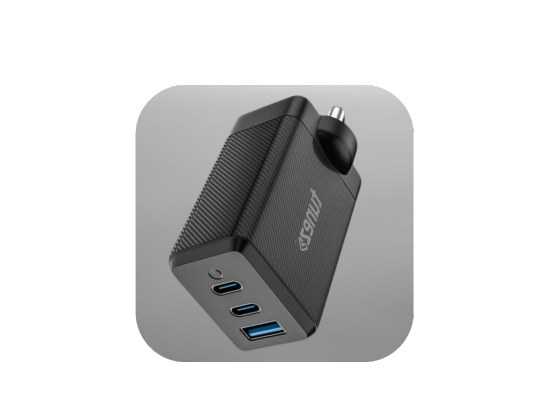
The Tunez CHG 01 is a strong example of GaN charging technology applied practically for Indian users — balancing compact design, broad compatibility, and intelligent power management at an accessible price point.
Specifications at a Glance
| Total Wattage | 65W |
| Ports | 3 (USB-C1, USB-C2, USB-A) |
| Input | AC 220V |
| Output | DC 65W |
| Colors | Black and White |
| Size Advantage | 40% smaller than standard 65W chargers |
USB-C Port Protocol Support (C1 — Primary)
- USB PD: 5V/3A, 9V/3A, 12V/3A, 15V/3A, 20V/3.25A
- PPS: 3.3–11V at 5A
This makes C1 ideal for charging laptops, including MacBook Air M1/M2 and 13-inch MacBook Pro, as well as any USB-C PD-enabled laptop at full speed.
USB-C Port Protocol Support (C2 — Secondary)
- USB PD: 5V/3A, 9V/2.22A, 12V/1.67A
C2 is optimized for smartphones and tablets at up to 20W.
USB-A Port Protocol Support
- Apple 2.4A, Samsung 5V/2A, DCP 1.5A, QC 2.0/3.0
- Samsung AFC: 9V
- Huawei FCP: 9V/12V
- Huawei SCP: 3.6–5.5V
The USB-A port handles virtually every fast-charging Android device through QC 3.0, Samsung AFC, and Huawei FCP/SCP — making this charger genuinely universal.
Intelligent Power Distribution
What separates a well-engineered GaN charger from a basic one is how it manages power when multiple ports are active simultaneously. The Tunez CHG 01 handles this intelligently:
- Single device (any port): Full 65W available
- Two USB-C ports active: C1 delivers 45W, C2 delivers 20W
- All three ports active: C1 delivers 30W, C2 delivers 15W, USB-A delivers 18W
This means you can charge a laptop, a smartphone, and a third device all at once from a single compact charger — without any port reverting to trickle charging.
Device Compatibility
- All iPhones and iPads (Lightning or USB-C)
- MacBook Air M1/M2, 13-inch MacBook Pro
- Samsung Galaxy flagship range
- Google Pixel devices
- Nothing Phone 1
- Nintendo Switch
- Any USB-C PD-enabled laptop or ultrabook
- Huawei and Honor devices via FCP/SCP protocol
How to Choose the Right GaN Charger
Step 1 — Identify Your Highest-Power Device
The wattage of the device that needs the most power determines the minimum wattage you need from your GaN charger.
- Smartphones only: 30W–45W is sufficient
- Tablets: 30W–45W
- Thin and light laptops (MacBook Air, Dell XPS): 45W–65W
- Full-size laptops (MacBook Pro 16", gaming laptops): 90W–140W
Step 2 — Count How Many Devices You Want to Charge Together
If you want to charge multiple devices simultaneously, choose a GaN charger whose total wattage comfortably covers the combined load. A 65W charger like the Tunez CHG 01 handles a laptop plus two smaller devices very comfortably.
Step 3 — Check Protocol Support
Make sure the charger supports the fast-charging protocol your device uses. For most Indian users, QC 3.0 (Android), USB PD (Apple and modern Android), and Samsung AFC cover the vast majority of devices.
Step 4 — Verify Safety Certifications
Look for built-in protections against:
- Overvoltage
- Overcurrent
- Overtemperature
- Short-circuit
These are non-negotiable for a charger that will be connected to expensive devices daily.
Step 5 — Consider Portability
If you travel frequently, look for foldable prongs and compact dimensions. GaN chargers are already much smaller than silicon equivalents at the same wattage, but some models are designed specifically for travel.
Real-World Use Cases for GaN Charging Technology
1. Work from home or office setup:
Replace three separate chargers on your desk with a single Tunez CHG 01. Your laptop, phone, and earbuds charge simultaneously from one outlet, cutting cable clutter dramatically.
2. Students and remote workers:
A single 65W GaN charger handles a MacBook or Windows laptop plus a phone and tablet. One charger replaces the three you would otherwise need to carry.
3. Frequent travelers:
The compact form factor means a 65W GaN charger takes up roughly the same space as a traditional 20W phone charger. Significantly more power in dramatically less bag space.
4. Content creators:
Running a laptop, a mirrorless camera (USB-C charging), and a phone simultaneously is straightforward with a multi-port GaN charger — keeping all your gear ready without hunting for multiple outlets.
5. Households with multiple devices:
A single 65W GaN charger on the kitchen counter or bedside table can serve the entire family across phones, tablets, and laptops without arguments over which charger belongs to which device.
Is GaN Technology Worth the Price Premium?
GaN chargers typically cost slightly more than equivalent silicon chargers upfront. Here is how that cost looks over time:
- Lower electricity consumption from higher efficiency saves money on electricity bills over months and years.
- Cooler operation means less thermal stress on both the charger and your devices — extending the lifespan of both.
- One GaN charger replaces multiple single-device silicon chargers — reducing the total number of chargers you need to buy.
For most users who own more than two chargeable devices, the switch to GaN technology pays for itself within a reasonable time frame through reduced clutter, reduced electricity use, and the elimination of the need for multiple separate chargers.
Why GaN Technology Is the Future of Charging
GaN charging technology is not a trend — it is a fundamental materials science improvement that makes every aspect of a charger better simultaneously. Smaller size, faster charging, cooler operation, broader compatibility, and longer lifespan all come from the same root cause: Gallium Nitride conducts electricity more efficiently than silicon at every level.
For Indian users looking for a reliable, compact, multi-device GaN charger, the Tunez CHG 01 65W delivers the full promise of GaN technology — intelligent power distribution across three ports, support for every major fast-charging protocol, and a build quality designed for daily use.
Switching to a GaN charger means fewer chargers on your desk, fewer cables in your bag, faster charging for every device you own, and a lower electricity bill over time. It is one of the most practical upgrades available for anyone who relies on multiple devices every day.
Buy mobile chargers that combine modern design reliable speed and safe charging technology to keep your devices powered up with ease.